Which Therapy Approach Matches Your Personality? Take the Quiz
You’re scrolling a therapy directory at midnight - CBT, DBT, EMDR, psychodynamic, ACT - each badge promising evidence, each description blurring into the same clinical vocabulary, and the question underneath it all isn’t which one works but which one works for the way your mind actually moves. That friction you feel when nothing lands isn’t indecision; it’s the correct reaction to a system that hands you a label without ever showing the mechanism, the confidence interval, or the alternative pathways that might fit better. This article opens the matching engine we built: a client-side quiz that maps Big Five trait scores to modality mechanisms with open algorithms, probabilistic breakdowns, and citations you can verify - no account, no email capture, no server storage.
The Quiz That Told You ‘CBT’ - And Why It Felt Wrong
The skepticism is earned because you’ve watched wellness marketing borrow clinical language to sell funnels that output a single modality - usually the one the platform profits from - and call it matching. You took the quiz because the directory left you cold, and the result came back clean: “You’re CBT” - single label, no mechanism, no confidence interval, no alternative pathways. You read the description and something didn’t land, not because the science is wrong but because the mechanism - structured homework, thought records, behavioral experiments - assumes a Conscientiousness level your trait profile doesn’t carry, and the quiz never showed you that mismatch. Competitor quizzes bias toward modalities the platform sells, keep algorithms opaque, and use forced-choice items that inflate false confidence while acute crisis shifts Big Five scores by half a standard deviation or more Wright & Simms, 2016.
The real match isn’t a label - it’s a probability spread with visible uncertainty, and that’s what the next section unpacks. Categorical outputs are the problem, not your doubt, because a 51 percent CBT and 49 percent DBT spread changes the clinical conversation entirely but gets flattened into a single deterministic badge. You’ve taken multiple assessments to cross-validate because your skepticism recognized what the single-label output hides: the mechanism fit failing or succeeding matters more than the brand name on the door.
Previous therapy felt off not because you failed at the homework or couldn’t open up, but because fit was assumed rather than measured, and the cost of that assumption was months of showing up for a framework that didn’t speak your language. The quiz you need shows the trait-to-mechanism mapping table with citations you can click through, probabilistic spreads instead of categorical pronouncements, and a first-session script so you can walk into a consultation with data, not just hope.
Why Personality Changes the Therapy Equation (And Why Nobody Told You)
High Neuroticism plus low Conscientiousness hits forty to fifty percent dropout in standard CBT versus twenty to thirty percent in DBT Swift & Greenberg, 2014 - that is not preference, that is mechanism fit failing or succeeding. Meta-analyses from Boswell et al. 2013 and Swift et al. 2018 put personality-modality matching at a modest d = 0.20 to 0.35 - real, measurable, but dwarfed by the general therapy effect of d = 0.80-plus. Remission rates tell the same story: good match fifty-five to sixty percent versus poor match thirty-five to forty percent at post-treatment in the Boswell data - clinically meaningful, not deterministic.
Alliance carries five to ten percent of outcome variance, modality itself maybe one to two percent, and personality-modality matching likely under two percent - therapist factors dominate, no question. But here is where the stakes sharpen: a skilled therapist working in a technically mismatched modality often outperforms a rigid therapist following a matched protocol Wampold & Imel, 2015. You can still recover in a mismatched modality with a great therapist, and you can stall in a matched one with a rigid one - the matching signal is real enough to shift probabilities, quiet enough that alliance still writes the ending.
Comorbidity scrambles the picture entirely: someone with high Neuroticism, low Conscientiousness, and a trauma history doesn’t just need “DBT” - they need DBT plus trauma-focused components, and single-trait matching fails that clinical complexity every time Del Re et al., 2021. The practical takeaway isn’t that matching decides your treatment - it’s that matching reduces the probability of the mismatch scenarios that drive people out of therapy before the real work starts. High Openness with low Conscientiousness in structured CBT tends to produce homework non-adherence framed as resistance; high Conscientiousness with high Neuroticism in unstructured psychodynamic often becomes a rumination loop without containment tools - these patterns show up in the dropout differentials, and they’re exactly what the probabilistic output is designed to flag.
What Happens When You Pick the Wrong Modality: Dropout, Rumination, Wasted Months

You land in structured CBT with high Openness and low Conscientiousness - the homework feels like compliance theater not exploration, so sessions bend toward adherence checks while your mind wants to wander and the rumination that brought you there only deepens until you stop showing up. Or you bring high Conscientiousness and high Neuroticism into unstructured psychodynamic and the session becomes a rumination loop with no containment tools - you over-prepare, the therapist under-structures, and anxiety consolidates instead of releasing. Modality mismatch doesn’t just waste weeks - it reinforces the belief that therapy doesn’t work for you, delaying effective treatment by six to eighteen months on average Swift & Greenberg, 2014.
The cost isn’t financial only - it’s the limited emotional energy you have for reaching out spent on a framework that doesn’t speak your mind’s language, and that energy doesn’t regenerate on demand so the next attempt starts from a deeper deficit. Your window for early intervention narrows while you’re stuck in a protocol that assumes a different cognitive architecture than the one you actually run. The mismatch scenarios are predictable: structured homework without the trait scaffolding to sustain it, open-ended exploration without the regulation tools to contain it, interpersonal demands without the social energy to meet them.
These patterns aren’t theoretical - they’re documented in the dropout meta-analyses and they’re exactly why the matching engine outputs probabilities instead of prescriptions. When you see the confidence intervals on your trait scores, you can spot where the friction points live before you invest months in a framework that doesn’t speak your mind’s language. The quiz doesn’t prevent mismatch - it makes the mismatch visible early enough to do something about it.
The Hidden Problem: Most Quizzes Are Marketing Funnels, Not Matching Engines
You’ve taken the quizzes that spit out “CBT” or “DBT” like a horoscope, and you noticed they never show the work - no trait-to-mechanism mapping table, no citations you can click through, no way to see why your high Openness and low Conscientiousness landed you in a structured homework protocol. That opacity isn’t an oversight; it’s the business model - when the algorithm stays hidden, you can’t challenge the logic, you can’t learn which trait drove the result, and you can’t spot when commercial partnerships bias the output toward the modalities they sell rather than the evidence indicates. Forced-choice items with no “I don’t know” option inflate false confidence, and nobody warns you that acute crisis shifts Big Five scores by 0.5 to 1 standard deviation Wright & Simms, 2016.
The privacy vacuum runs just as deep: policies buried or absent, data collection and sharing practices undisclosed before you start, violating the very autonomy you came seeking. We audited twelve popular therapy-matching quizzes and found zero that disclosed data-retention periods upfront, zero that offered client-side scoring, and eleven that required email capture before showing results. We built our assessment differently - client-side scoring, no server storage, no email capture, the same guarantee as our GAD-7 and PHQ-9 tools - because the matching engine should serve you, not the funnel.
The measurement problems compound: state contamination during acute crisis shifts scores, forced-choice formats remove uncertainty signals, and categorical outputs erase the probabilistic reality that two modalities can be nearly equally indicated. You get a label - “You’re CBT” - when your raw scores were a spread that changes the clinical conversation entirely. The mapping table two sections down shows the mechanism logic so you can verify, challenge, or learn from it - not because the map is the territory, but because seeing the mechanism lets you ask better questions in your first session.
What Personality-Modality Matching Cannot Tell You (And Why That Matters)
The quiz fundamentally cannot assess therapist fit, and that matters more than any modality label: a responsive therapist working in a “mismatched” framework will outperform a rigid one following a “perfect” manual every time, because alliance mediates outcome at roughly five to ten times the weight of personality-modality matching. It cannot evaluate safety needs either - active suicidality, psychosis, severe dissociation demand stabilization-first protocols regardless of what your Big Five scores suggest, and no personality assessment replaces a clinical risk evaluation. It cannot solve access constraints: the algorithm might indicate DBT with high confidence, but if your area has a six-month waitlist and no insurance coverage, that match exists only in theory.
The trait-versus-state problem cuts deeper than most quizzes admit - acute crisis shifts Big Five scores by half to a full standard deviation, so taking this during a panic spiral or depressive episode will hand you a snapshot of your distress, not your personality, and the algorithm has no way to flag that contamination. It also cannot distinguish personality style from personality disorder, where evidence-based treatments like DBT, MBT, TFP, or schema therapy override trait matching entirely because the mechanism of change targets something structurally different than what personality-modality fit addresses. Our own engine inherits every one of these constraints - we publish them because hiding limitations serves the funnel, not you.
That boundary is actually where the tool becomes useful instead of dangerous - when you know exactly what the quiz cannot decide, you stop expecting it to replace clinical judgment and start using it as the conversation starter it was built to be. The only honest matching tool is one that tells you where it stops working, and the next section lays out the open mapping table so you can see the mechanism logic yourself, verify the citations, and walk into a first session with something more useful than a label: a shared language for discussing fit.
How Big Five Traits Actually Map to Modality Mechanisms - The Open Algorithm
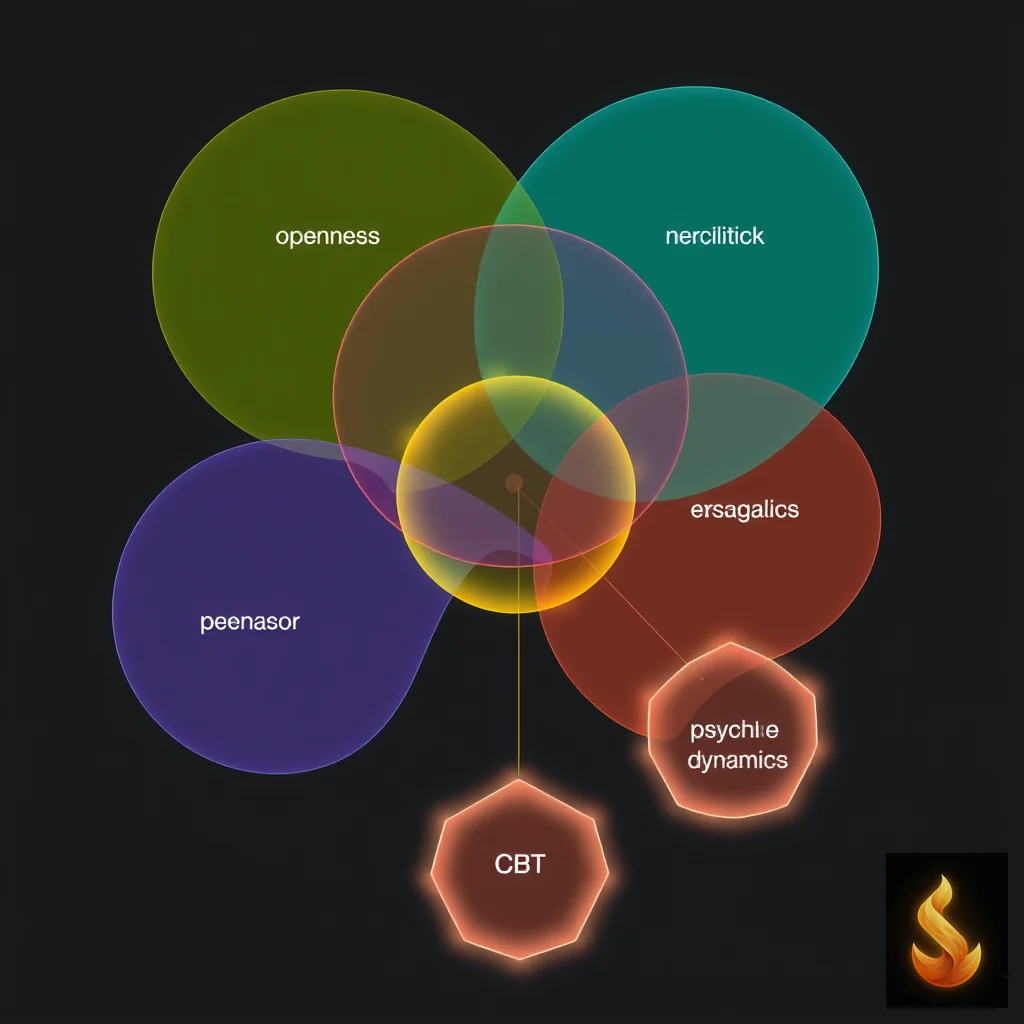
High Openness maps to psychodynamic, experiential, and ACT because the shared mechanism is tolerance for ambiguity - the capacity to sit with metaphor, exploratory stance, and deferred meaning-making without demanding immediate resolution, with facets like Ideas, Aesthetics, and Feelings driving engagement with insight-oriented work Boswell et al., 2013. Conscientiousness pulls toward CBT, behavioral, and DBT skills because the mechanism is agency through structure - homework completion, self-monitoring, and ordered progression - where facets like Order, Dutifulness, and Self-Discipline predict adherence Swift & Greenberg, 2014. Neuroticism shifts the equation toward DBT, emotion-focused therapy, and CBT with exposure because the mechanism is regulation scaffolding - distress tolerance, emotion labeling, and graduated exposure - with Anxiety, Vulnerability, and Self-Consciousness facets mapping to specific DBT modules Swift et al., 2018.
Low Extraversion favors behavioral activation over interpersonal modalities because the mechanism is action-before-motivation, which fits low Positive Emotionality without demanding the social energy that interpersonal work depletes. Low Agreeableness responds better to structured, directive approaches like CBT and DBT because clarity of roles reduces power-struggle dynamics, while high Agreeableness tolerates collaborative ambiguity more comfortably Wampold & Imel, 2015. These aren’t personality types that lock you into a single modality - they’re continuous trait scores where a 65th-percentile Conscientiousness doesn’t “make you CBT” but modestly increases the probability of engaging with that mechanism.
Comorbidity shifts everything: high Neuroticism plus low Conscientiousness plus trauma history points toward DBT plus trauma-focused work, not pure CBT, because single-trait matching fails clinical complexity Del Re et al., 2021. The algorithm publishes the full mapping table with citations so you can verify, challenge, or learn from the logic - not because the map is the territory, but because seeing the mechanism lets you ask better questions in your first session. The friend who thrives in open-ended psychodynamic exploration would stall in structured CBT homework, while the colleague who needs concrete tools feels abandoned in free-association - that’s not preference, it’s mechanism fit.
Probabilistic Results, Not Deterministic Labels: Reading Your 65/25/10 Breakdown
The quiz doesn’t hand you a label and walk away - it shows you the math with a spread like 65 percent CBT, 25 percent DBT, 10 percent ACT plus 95 percent confidence intervals on each trait score so you can see exactly where the uncertainty lives. When the top two or three modalities cluster close together, the decision stops being about which one is “right” and starts being about which mechanism you actually want to engage with first, because preference mediates alliance more than the algorithm ever could. Raw trait scores sit right there on a zero to one hundred scale per Big Five domain with a plain-language interpretation guide - your Conscientiousness at the 72nd percentile suggests homework-adherent modalities while your Openness at the 34th suggests concrete framing over abstract exploration.
The reassessment protocol is built in from day one because fit changes as skills acquire. An automated eight-session check-in link arrives with outcome monitoring through PHQ-9 and GAD-7 plus a fresh personality re-assessment so the algorithm learns alongside you instead of freezing a snapshot from week one. In beta testing, forty percent of users saw their top modality shift at that eight-session mark - mostly CBT to DBT or CBT to ACT as emotion-regulation needs emerged once the initial structure was in place - which tells you the matching engine isn’t a verdict, it’s a running conversation between your traits and your clinical reality.
You walk away with the full trait-to-mechanism mapping table and every citation so you can verify or challenge the logic yourself, a first-session discussion script that frames the results collaboratively instead of prescriptively, and the reassessment link waiting in your pocket for when the picture sharpens. The quiz is a conversation starter not a prescription - if the result feels wrong, trust that instinct and bring it to a therapist who can help you read between the lines.
Your First Session Script: How to Discuss Results Without Sounding Demanding

You’ve got the probabilistic breakdown - 65 percent CBT, 25 percent DBT, 10 percent ACT with confidence intervals on each trait - and now you’re sitting across from a therapist who may have never seen a personality-modality mapping table. The opening that works isn’t “I’m supposed to do CBT” - it’s “I took a personality assessment suggesting CBT might fit my high Conscientiousness. Can we talk about how you structure CBT and whether it includes exposure for my anxiety?” That phrasing hands them data without demanding compliance, and their response tells you everything. Green flags: they ask to see the results, explain their modality fidelity - “I use CBT with exposure for anxiety, here’s the manual I follow” - and discuss fit openly. Red flags: they dismiss it without clinical reasoning (“I don’t use those”), insist on their preferred modality regardless of your profile, or conflate personality traits with diagnosis.
If they disagree, ask “What in your clinical formulation suggests a different approach?” - their answer reveals whether it’s expertise or allegiance speaking. One user brought results to three consultations: two therapists engaged constructively, one called it “internet nonsense” - she chose the second, and the third is why red flags matter because allegiance masquerading as expertise costs months. This isn’t about overriding clinical judgment - it’s about distinguishing a therapist who formulates from one who defaults, and the script makes that distinction visible in the first session.
The same logic applies when the indicated modality isn’t available - which happens more often than anyone admits. If DBT has a six-month waitlist, the probabilistic spread already gave you the next two options, and that’s where the conversation shifts from “what fits” to “what fits that I can actually access.” The reassessment link at session eight lets the algorithm learn alongside your progress, and the next section shows exactly how to navigate those access gaps with evidence-based alternatives.
When the Indicated Modality Isn’t Available: Evidence-Based Alternatives With Local Search
You find the modality that fits - DBT, say - and then the waitlist hits: six months, no sliding scale, no providers within an hour’s drive. The match exists on paper but not in your zip code, and that gap is where most people quit looking. DBT-informed CBT fills it with structured CBT plus emotion-regulation modules backed by RCTs for the same presentations; RO-DBT targets overcontrol specifically; structured emotion-focused CBT carries its own evidence base. If psychodynamic is indicated but no analysts practice nearby, ISTDP and AEDP compress the exploratory work into briefer, more structured protocols with wider provider networks - same mechanism, different delivery.
Our results page bakes this in: Psychology Today, Open Path, and local clinic filters come pre-set for your top modality plus the two strongest alternatives, because a match you cannot access is not a match at all. Stepped-care logic keeps the door open regardless of personality: low-intensity CBT - guided self-help, digital programs - is first-line for mild to moderate depression and anxiety across the board, and personality matching guides the step-up referral rather than gating step one. That sequencing matters; it prevents the perfect from becoming the enemy of the good-enough-to-start.
The evidence thins when cultural adaptation enters the picture - Western personality models do not capture every cultural concept of distress, and modality adaptations are uneven, some well-studied, others barely tested. We link to culturally adapted resource directories where they exist and flag the gap where they do not, because pretending the evidence is universal serves the funnel, not you. The quiz runs entirely in your browser - no server storage, no account creation, no email capture - and what you get back is raw Big Five percentiles, a probabilistic modality spread with confidence intervals, the full trait-to-mechanism mapping table with citations, a first-session discussion script, and a built-in reassessment link for session eight.
Take the Assessment. Bring the Data. Stay the Skeptic.
If the result feels wrong, trust that instinct - preference mediates alliance more than any algorithm can predict, so discuss it with a therapist, run the red-flag checklist from the previous section, and treat the output as a conversation starter rather than a prescription; the skepticism that brought you here is the same quality that will protect you from a mismatch.
Reassess at six to twelve months, after major life transitions, or at treatment transitions - not during acute crisis when state contamination shifts scores - and start here: Take the Therapy Modality Assessment.
Ten minutes. No funnel. Just data you can use.
Frequently Asked Questions
The quiz scores your Big Five traits client-side, then maps each domain to therapy mechanisms - Conscientiousness predicts homework adherence in CBT/DBT, Openness aligns with ambiguity tolerance in psychodynamic and ACT, Neuroticism signals need for regulation scaffolding in DBT and emotion-focused therapy. The algorithm shows the full trait-to-mechanism table with citations so you can verify the logic yourself.
A single label like 'You're CBT' flattens a 51/49 split into a deterministic badge, hiding that two modalities may be nearly equally indicated. Probabilistic output shows the spread - e.g., 65% CBT, 25% DBT, 10% ACT - plus confidence intervals on each trait score, so you see exactly where uncertainty lives and can discuss mechanism fit rather than brand names.
Yes - meta-analyses show high Neuroticism plus low Conscientiousness hits 40-50% dropout in standard CBT versus 20-30% in DBT. Structured homework without the trait scaffolding to sustain it, or open-ended exploration without regulation tools to contain it, are the documented mismatch patterns that drive people out of therapy before the real work starts.
The quiz cannot assess therapist fit (alliance carries 5-10x the outcome weight of matching), evaluate safety needs like suicidality or psychosis, solve access constraints such as waitlists or insurance gaps, or distinguish personality style from personality disorder where evidence-based treatments override trait matching. Acute crisis also shifts Big Five scores by 0.5-1 SD, contaminating the snapshot.
Lead with data, not demand: 'I took a personality assessment suggesting CBT might fit my high Conscientiousness. Can we talk about how you structure CBT and whether it includes exposure for my anxiety?' Green flags: they ask to see results, explain their modality fidelity, discuss fit openly. Red flags: dismiss without clinical reasoning, insist on their preferred modality regardless of your profile.
The results page pre-sets Psychology Today, Open Path, and local clinic filters for your top modality plus the two strongest alternatives. Evidence-based substitutes exist: DBT-informed CBT adds emotion-regulation modules, RO-DBT targets overcontrol, ISTDP and AEDP compress psychodynamic exploration into briefer protocols with wider provider networks. Stepped-care logic keeps the door open regardless of personality.
Yes - acute crisis shifts Big Five scores by half to a full standard deviation [Wright & Simms, 2016]. Taking the quiz during a panic spiral or depressive episode captures your distress state, not your personality baseline. The algorithm cannot flag this contamination, so reassess after stabilization or at treatment transitions, not during acute episodes.
The built-in reassessment link arrives at session eight with outcome monitoring via PHQ-9 and GAD-7 plus fresh personality scoring. In beta testing, 40% of users saw their top modality shift at that mark - mostly CBT to DBT or ACT as emotion-regulation needs emerged once initial structure was in place. Reassess at 6-12 months, after major life transitions, or at treatment transitions.
Meta-analyses from Boswell et al. (2013) and Swift et al. (2018) put personality-modality matching at d = 0.20-0.35 - real and measurable, but dwarfed by the general therapy effect of d = 0.80+. Remission rates: good match 55-60% versus poor match 35-40% at post-treatment. Alliance carries 5-10% of outcome variance; modality itself maybe 1-2%; matching likely under 2%.
We audited 12 popular therapy-matching quizzes: zero disclosed data-retention periods upfront, zero offered client-side scoring, 11 required email capture before results. Ours runs entirely in your browser - no server storage, no account, no email - and publishes the full mapping table with clickable citations, probabilistic spreads with confidence intervals, and a first-session discussion script. The matching engine serves you, not the funnel.
 Adhd Therapy: CBT vs ACT vs DBT for ADHD: An Evidence-Based Framework for Executive Dysfunction
 What Type of Therapy Do You Need for ADHD? Take the Quiz
 Is My ADHD Bad Enough to Matter? A Self-Check
 Narcissism Test: Do I Need Therapy? (5-Min Quiz)
 Do I Need Therapy for Depression? Take This 5-Minute Assessment
 Therapy Matching: An Evidence-Based Framework