When You're Too Shameless: Pathological Lack of Guilt and How to Change
You’ve been told you “lack empathy” multiple times. Different people, different situations, same feedback. Your response? They’re too sensitive. They don’t understand. They’re holding you back.
Here’s the uncomfortable question: What if you’re pathologically shameless?
This isn’t about healthy shamelessness - the kind that lets you set boundaries, speak truth, or act despite judgment. This is the opposite extreme: an impaired ability to feel remorse, process feedback, or recognize when you’ve genuinely harmed others.

This article serves two audiences. If someone sent you this link and you’re already defensive, you’re probably in the first group. If you’re trying to understand someone who seems incapable of guilt, you’re in the second.
One thing before we start: If you’re thinking “I don’t have a problem” - that’s the problem. People with pathological shamelessness can’t see it in themselves.
What Pathological Shamelessness Looks Like (Clinical Picture)
Pathological shamelessness has five core features:
1. Impervious to feedback - Criticism slides off like water. You rationalize, deflect, or dismiss it within seconds.
2. Burned bridges - A pattern of severed relationships where the other person is always “the problem.”
3. Absence of remorse - When confronted with harm you’ve caused, you feel irritation at being confronted - not guilt for the action.
4. Chronic justification - Every action has a reason. You were stressed. They deserved it. It was necessary.
5. Exploitation without discomfort - You use people instrumentally (for status, resources, validation) and feel no ethical pull against it.
This manifests in two primary clinical presentations:
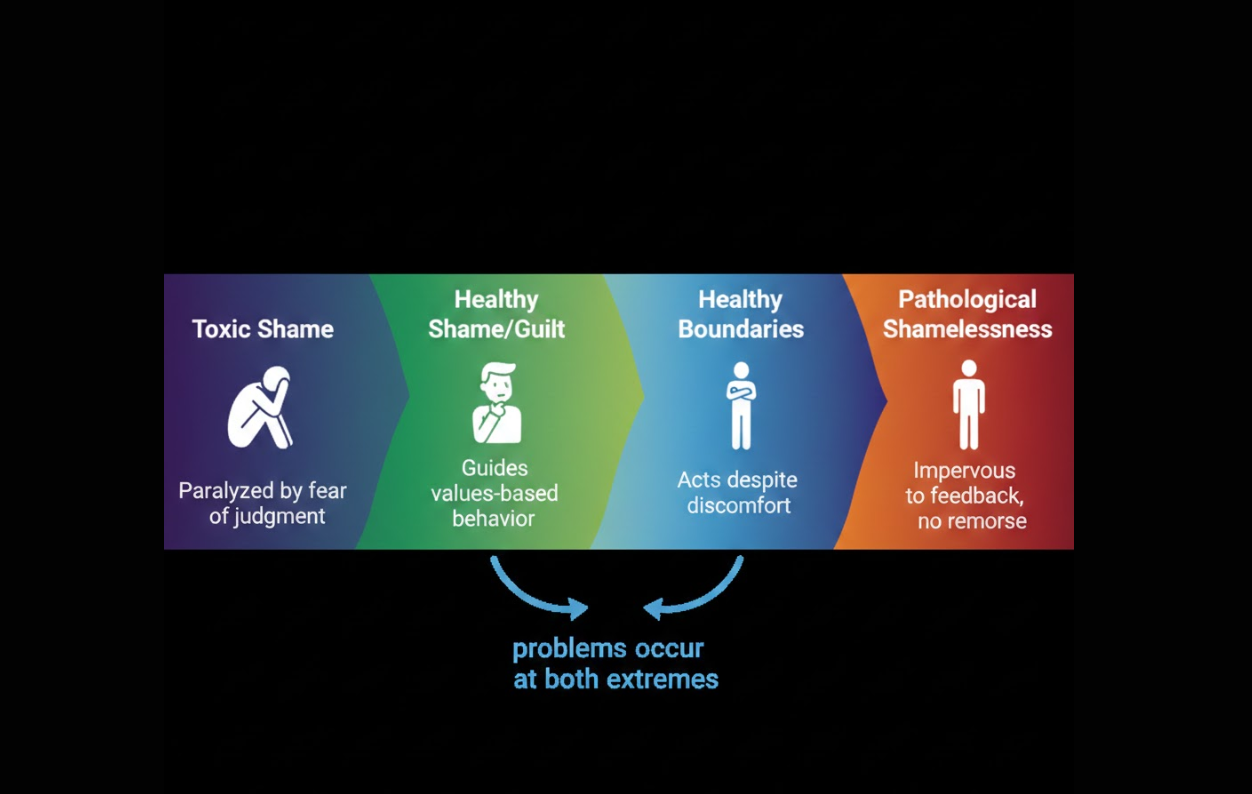
Narcissistic Personality Disorder (NPD)
NPD means grandiosity, exploiting others, and barely any empathy. Brain imaging studies show that people with narcissistic traits have less brain activity in areas that respond to others' pain. A 2024 study confirmed they’re worse at reading others' emotions.
Here’s the twist: The shamelessness isn’t real confidence. It’s defensive armor. NPD develops to protect against feeling worthless. You became impervious to avoid collapse.
Antisocial Personality Disorder (ASPD)
ASPD means lying, breaking rules, hurting people, and feeling nothing about it. Unlike NPD (where shamelessness protects a fragile ego), ASPD is a deeper problem - the conscience barely exists.
About 1-4% of people have ASPD, with much higher rates in prisons. It’s one of the hardest personality disorders to treat.
Example: Alex’s Pattern
Alex fired an employee via text while on vacation. When confronted by the team about the callousness, Alex’s response focused entirely on personal stress levels and the employee’s performance issues. Zero acknowledgment of the human impact. When HR mandated a conversation, Alex felt victimized by the requirement - not remorseful about the action.
Five different people had told Alex the same thing over ten years. Alex’s conclusion? “I work with a lot of fragile people.”
The Consequences You’re Not Seeing (Because That’s the Problem)
The paradox: Pathological shamelessness numbs you to the very feedback that would reveal its consequences. You’re insulated from recognizing the damage.
Six Consequences You Might Not Recognize
a. Isolation Disguised as Independence
You tell yourself you prefer solitude, that you’re self-sufficient. Reality: People have stopped trying to connect because connection with you feels unsafe.
b. Stagnation Disguised as Self-Assurance
You view yourself as confident and self-aware. Reality: You haven’t changed in years because you dismiss every piece of feedback that could help you grow.
c. Manipulation Disguised as Authenticity
You pride yourself on “telling it like it is” and “not playing games.” Reality: You exploit others' authenticity while remaining strategically opaque yourself.
d. Loneliness Disguised as Strength
You interpret emotional self-containment as resilience. Reality: You’re cut off from genuine intimacy because intimacy requires vulnerability you can’t access.
e. Legal/Professional Consequences
Research on ASPD outcomes shows individuals with antisocial personality disorder commit significantly more offenses and experience higher rates of incarceration when untreated.
f. Disconnection from Reality
The ultimate consequence: Your internal narrative diverges so far from others' experience of you that you’re essentially living in a different reality.
Self-Assessment Checklist
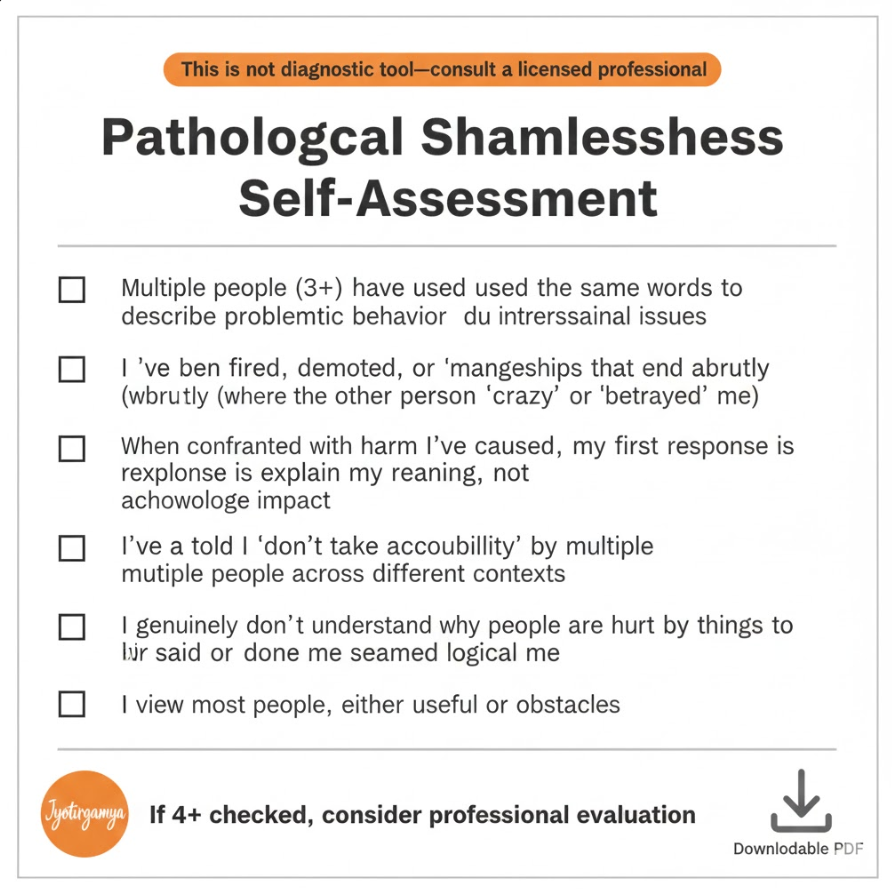
Check each item that applies to you:
- Multiple people (3+) have used the same words to describe problematic behavior in me
- I’ve been fired, demoted, or “managed out” of positions due to interpersonal issues
- I have a pattern of intense relationships that end abruptly (where the other person was “crazy” or “betrayed” me)
- When confronted with harm I’ve caused, my first response is to explain my reasoning, not acknowledge impact
- I’ve been told I “don’t take accountability” by multiple people across different contexts
- I genuinely don’t understand why people are hurt by things I’ve said or done that seemed logical to me
- I view most people as either useful or obstacles
Interpretation: If 4-5 items apply, you have a significant pattern requiring professional evaluation. If 6-7 items apply, this is severe - seek specialized help immediately. If items 1, 3, and 4 all apply together (multiple people say the same thing, you explain instead of apologize, you’re told you don’t take accountability), that’s the core pattern and highest priority.
The Brutal Truth: Can Pathologically Shameless People Change?
Short answer: Maybe. But it requires years of sustained discomfort.
Research Evidence for NPD
A small study tracking 8 NPD patients in psychotherapy for 2.5-5 years found that at completion, all patients had improved and no longer met criteria for NPD. This sounds promising until you see the context.
NPD is associated with a 63-64% dropout rate from psychotherapy - substantially higher than general psychotherapy dropout rates. This means for every person who completes treatment, nearly two others quit.
Why? Because the treatment feels like sustained psychological torture. You must repeatedly face that you’re the problem. You have to sit with shame you’ve spent a lifetime avoiding. You need to accept that your self-narrative is distorted. And you must tolerate others' pain without defending yourself.
Research Evidence for ASPD
Mentalization-based treatment (MBT) for ASPD shows promise. In randomized controlled trials, participants who received MBT-ASPD committed 46% fewer offenses three years post-treatment compared to probation alone.
But ASPD is still one of the hardest personality disorders to treat. Most clinicians remain pessimistic about outcomes. Progress is slow, treatment is intensive, and many people don’t engage seriously.
What “Change” Actually Means
Don’t expect a full emotional transformation. Change looks like:
Cognitive Empathy - Learning to recognize others' perspectives intellectually (even if you don’t feel them)
Impulse Control - Stopping yourself from harmful behaviors because you know the consequences
Behavioral Change - Acting differently even when you don’t want to
This isn’t Hollywood redemption. It’s slow, uncomfortable skill-building that may never feel natural.
What Change Requires
First, you need admission. This means acknowledging the pattern exists and you’re the common denominator. Not them. You.
Second, tolerance for discomfort. You’ll sit with shame, guilt, and vulnerability for years.
Third, external accountability. Your internal gauge is broken. You need other people to tell you when you’re off track.
Fourth, 2-5 years of therapy. Not months. Not a dozen sessions. Years of work with a specialized clinician.
Fifth, acceptance of limits. You may never “feel” empathy the way most people do - the automatic emotional response to others' pain. But you can learn to recognize it intellectually and act accordingly. Progress looks like pausing before reacting, asking “How did that affect you?” and changing behavior based on the answer.
The Catch-22
The very traits that need to change prevent engagement with change processes. You need humility to enter therapy - but lack of humility is the problem. You need to tolerate feedback - but imperviousness to feedback is the symptom.
Dr. Elsa Ronningstam, expert on NPD, notes: “The grandiosity and entitlement that characterize NPD also make individuals resistant to recognizing they need help. They often enter treatment only when facing major consequences - divorce, job loss, legal issues - and may leave once the external pressure resolves.”
The Hard Question
Complete this sentence without justification or explanation:
“The pattern in my relationships where I am repeatedly told I lack empathy or don’t take accountability exists because __________.”
If you can’t write “because I have impaired ability to recognize my impact on others,” you’re not ready for change.
The 4-Step Reversal Process (How to Cultivate Healthy Guilt)
If you’ve made it this far without dismissing this article, you’re already in the minority. Most people with pathological shamelessness click away within the first few paragraphs. Here’s the clinical roadmap.
Step 1: Acknowledge the Pattern (Not Just Incidents)
The work isn’t admitting you were wrong about one thing. It’s recognizing you have a systemic pattern of being wrong about your impact on others.
Exercise: Pattern Recognition Worksheet
| Person | What They Said | My Initial Response | Situation | Outcome |
|---|---|---|---|---|
| Ex: Sarah | “You never apologize, you just explain” | “She’s too emotional” | Argument about canceling plans | She ended friendship |
Fill out 5 incidents. Look for the pattern across the rows.
Critical question: If 5+ people across different contexts say the same thing about you, who’s more likely wrong: all of them, or you?
Step 2: Understand Your Defensive Armor
Why did imperviousness develop in the first place? Most people have a combination of these origins, though one usually dominates.
Maybe it was childhood emotional abuse. Shamelessness developed as protection against relentless criticism. Or attachment trauma - vulnerability led to abandonment, so you eliminated vulnerability entirely. Sometimes it’s an early narcissistic injury, a core wound to self-esteem that required defensive grandiosity to survive. Or it’s reinforcement history: exploitation worked, you got what you wanted, and empathy was never rewarded.
Here’s the NPD paradox: Your shamelessness defends against unbearable shame. You can’t tolerate guilt because underneath is a terror that you’re fundamentally defective.
Ask yourself these questions. When in my life did being vulnerable result in being hurt? What would it mean about me if I accepted I’ve genuinely harmed people? What am I protecting by not acknowledging my impact?
Research on NPD defensive structures confirms: “Narcissistic defenses serve to protect a fragile self-structure from perceived threats. The grandiosity is compensatory - a defense against shame rather than evidence of genuine self-regard.”
Step 3: Practice Cognitive Empathy
You may never “feel” others' pain the way neurotypical people do. But research shows you can learn to recognize it intellectually.
A 2024 study demonstrated that individuals with high narcissistic traits can activate empathy-related neural circuits when explicitly instructed to take others' perspectives - suggesting the capacity exists but requires conscious effort.
The Perspective-Taking Protocol (5 Steps):
Step 1: PAUSE - Count to 10. Don’t speak. Override your reflex to defend or explain.
Step 2: REFLECT - Repeat back what they said: “You felt [emotion] when I [action].”
Step 3: CLARIFY - Ask: “What impact did that have on you?” Listen without planning your response.
Step 4: SIT - Allow the discomfort to exist for 30 seconds. Don’t fix it. Don’t defend. Just tolerate it.
Step 5: ACKNOWLEDGE - Say: “I can see that affected you.” (Not “I’m sorry you feel that way” - that’s a non-apology)
Practice exercise: Work through this protocol on paper for one past incident where someone said you hurt them. Write out each step. Notice where you want to justify or explain.
Acknowledgment: This will feel mechanical at first. That’s expected. You’re building a skill that didn’t develop naturally.
Step 4: Create External Accountability
Reality: Your internal gauge is broken. You need external calibration.
Find a trusted feedback person. This is someone who will tell you hard truths. Grant them explicit permission to call out patterns. Check in weekly, not when you feel like it.
Practice apologies. Commit to one genuine apology per week for six months. Use this format: “I [specific action]. That affected you by [impact]. I was wrong to [what you did].” No “but” at the end. No justification.
Track consequences. Journal every time someone pulls away, ends contact, or expresses hurt. Review monthly for patterns you’re missing in the moment.
Create behavioral contracts. Work with your therapist or a trusted person to establish specific behaviors to change. Examples: “I will not interrupt when receiving feedback” or “I will ask ‘How did that affect you?’ once per conflict.”
The Paradox: You became shameless to avoid pain. But the absence of healthy shame has created a different kind of pain - isolation, stagnation, and disconnection from reality.
Which pain will you choose?
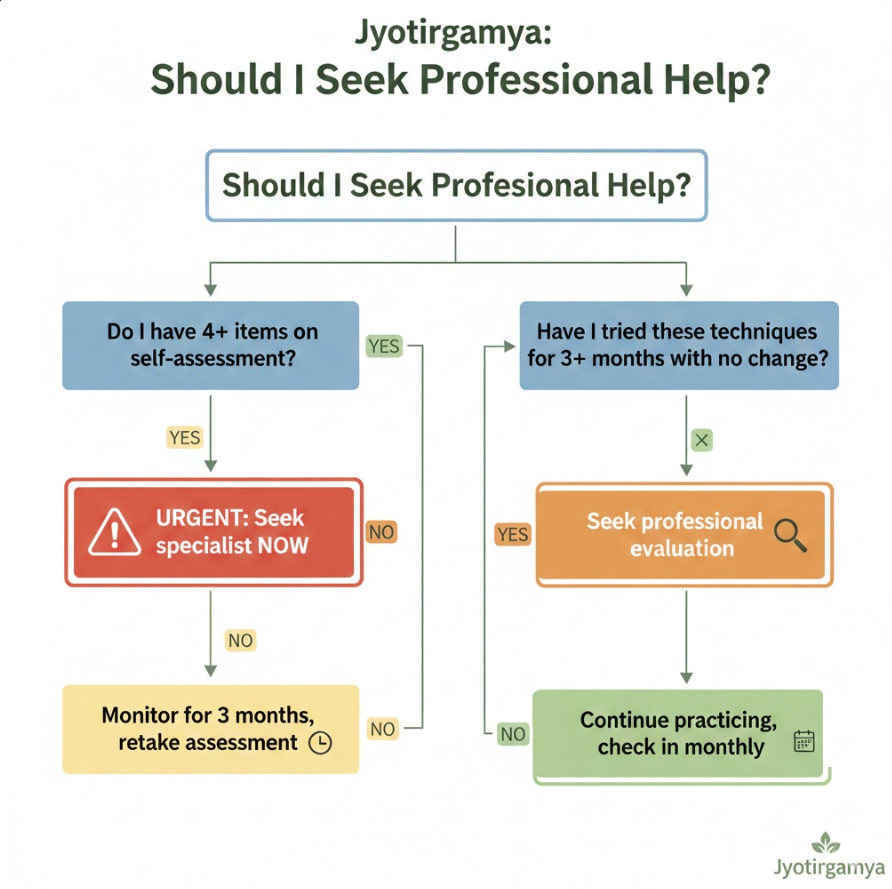
When This Requires Professional Intervention (And It Probably Does)
Reality check: Self-help won’t be enough for pathological shamelessness. This is a personality-level issue requiring specialized treatment.
Conditions Featuring Impaired Shame
Both NPD and ASPD feature impaired shame, but the mechanism differs. NPD uses shamelessness as defensive armor. ASPD reflects deeper conscience impairment.
When Self-Help Won’t Cut It
Seek professional evaluation immediately if you have:
- Legal consequences related to interpersonal behavior (assault charges, restraining orders, workplace litigation)
- Multiple job losses due to “interpersonal issues”
- Pattern of relationships ending with the other person claiming emotional abuse
- Substance abuse issues alongside interpersonal problems
- Suicidal ideation or self-harm (often in NPD when narcissistic injury occurs)
- Violent ideation or behavior toward others
If you’re in crisis: National Suicide Prevention Lifeline: 988 | Crisis Text Line: Text HOME to 741741
- Complete inability to identify any wrongdoing in relationship conflicts
- Someone you trust has explicitly stated they fear you or feel unsafe around you
Three Therapeutic Approaches That Work
1. Schema Therapy Research shows a 23.3% dropout rate for personality disorders (compared to 63% for NPD in general treatment). Focuses on identifying and changing maladaptive patterns developed in childhood.
2. Mentalization-Based Therapy (MBT) Particularly effective for ASPD. Clinical trials demonstrate 46% reduction in offenses. Teaches understanding of mental states in self and others. Works well in group format for real-time feedback.
3. Transference-Focused Psychotherapy (TFP) Uses your relationship with the therapist to show you how you relate to everyone else. Long-term, intensive work that addresses core relational patterns.
Finding the Right Therapist
You need someone with specialized training in personality disorders, not general practice. Look for: certification in Schema Therapy, TFP, or MBT; at least 5 years post-graduate experience; and willingness to work long-term (2-5 years minimum). They should provide direct confrontation, not just supportive listening.
Search the Psychology Today directory and filter for “Narcissistic Personality” or “Antisocial Personality.” Check the Schema Therapy Institute directory, the International Society for Schema Therapy (ISST), or the Mentalization-Based Treatment Institute.
Red flag: If you’ve seen 3+ therapists and each one “failed to understand you” or “wasn’t helpful” - the pattern is you, not them.
Cost Reality
Specialized treatment for personality disorders typically costs $150-$300 per session in private practice. You’ll need 1-2 sessions per week for 2-5 years. Total: $15,600-$78,000 over the full treatment course.
Compare this to the cost of not changing. Lost income from job terminations. Legal fees from workplace litigation or criminal charges. Divorce settlements. Lifelong isolation and relationship dysfunction.
Warning Signs It’s Urgent
Seek immediate professional help if you’re facing imminent legal consequences related to interpersonal behavior, if someone has obtained a restraining order against you, if you’re experiencing suicidal thoughts after narcissistic injury, or if you’ve engaged in violence or credible threats toward others.
Conclusion
Being too shameless doesn’t make you confident. It makes you disconnected.
The real question: Are you willing to feel the discomfort you’ve spent a lifetime avoiding?
Your move: Call a therapist specializing in personality disorders today. Not next week. Today.
Paradox to sit with: The shamelessness you built as protection has become a prison. The walls that kept shame out also keep connection out.
Which matters more: being right, or being connected?
Resources
Find a Schema Therapy specialist at schematherapy.com or search the International Society for Schema Therapy directory.
Disclaimer: This article is for educational purposes only and does not constitute clinical diagnosis or treatment. If you believe you have NPD, ASPD, or other personality disorders, consult a licensed mental health professional specializing in personality disorders. The self-assessment is not a diagnostic tool.
Related Reading
How to Be Shameless: Healthy Boundaries Without Guilt
When Persistence Becomes Shamelessness: Finding the Line
The Psychology of the Egoistic Person
Sources:
- Dissecting Narcissism: Empathy Pathology and Neurobiology
- The Dark Side of Empathy in NPD
- Narcissistic Traits and Reduced Empathic Accuracy
- Neural Correlates of Narcissistic Personality Disorder
- Examination of Empathy Changes After ADHD Treatment
- Can Patients With NPD Change?
- Dropout and Narcissism in Psychotherapy
- Schema Therapy Dropout Rates
- Mentalization-Based Treatment for ASPD
- MBT-ASPD and Therapeutic Optimism
- MOAM Trial Protocol